



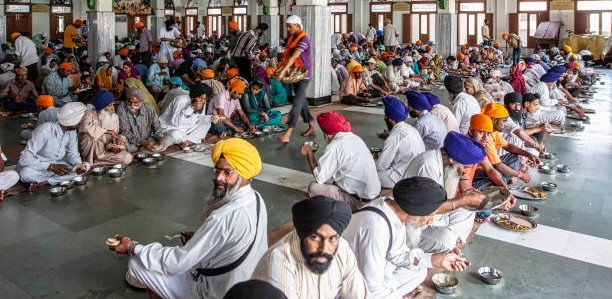
Langar (लंगर)
Langar is a fundamental practice in Sikhism, embodying the principles of equality, community, and service. It refers to the communal kitchen and free meal served to all visitors, regardless of religion, caste, gender, or social status, in a Gurdwara (Sikh place of worship) or at Sikh community events. Here’s a concise overview:
Key Aspects of Langar
Purpose and Philosophy:
-
-
Langar promotes equality by having everyone sit together on the floor (pangat) to share a meal, breaking down social barriers.
-
It reflects seva (selfless service), as volunteers prepare, cook, serve, and clean without expecting reward.
-
It embodies sangat (community), fostering unity and compassion among diverse groups.
-
The practice aligns with Sikh values of sharing, humility, and devotion to God.
-
History:
-
-
Initiated by Guru Nanak, the founder of Sikhism, in the 15th century, who emphasized feeding the hungry as an act of spiritual service.
-
Institutionalized by Guru Angad and expanded by Guru Amar Das, who required all visitors to partake in langar before meeting him, reinforcing equality.
-
Guru Arjan and Guru Hargobind further developed langar as a community institution, with contributions from devotees (dasvandh) sustaining it.
-
Operation:
-
-
Langar is typically vegetarian to accommodate all dietary restrictions and promote inclusivity.
-
Meals are simple, nutritious, and wholesome, often including dishes like dal (lentils), sabzi (vegetables), roti (flatbread), rice, and kheer (rice pudding).
-
Funded by donations and prepared by volunteers, langar operates on the principle of karam yoga (selfless action).
-
It is served at all times in major Gurdwaras, such as the Golden Temple in Amritsar, which feeds tens of thousands daily.
-
Significance:
-
-
Langar is a practical expression of Sikh teachings against discrimination and hierarchy.
-
It serves as a reminder of humility, as even the wealthy and powerful sit alongside the poor.
-
It provides food security to those in need, acting as a model of social welfare.
-
During crises (e.g., natural disasters, pandemics), Sikh communities often set up langar to serve affected populations globally.
-
Modern Context:
-
-
Langar is practiced worldwide in Gurdwaras and during Sikh festivals or outreach programs.
-
Sikh organizations, like Khalsa Aid, extend langar to disaster zones, refugee camps, and marginalized communities.
-
It has inspired interfaith dialogues and community service initiatives globally, showcasing Sikhism’s commitment to humanity.
-
Cultural and Spiritual Impact
Langar is more than a meal; it’s a spiritual act that reinforces Sikh values of equality, service, and devotion. It challenges societal divisions and fosters a sense of global community. Visitors to a Gurdwara are encouraged to participate in langar, either by eating or volunteering, to experience its ethos firsthand.